Narendra Modi's Varanasi Redevelopment and the Cost of Progress
There are multiple ways to arrive at Manikarnika Ghat, the riverfront ground that has for hundreds of years been considered by Hindus to be the most sacred spot for cremating the dead. The ghat stands close to the antargriha, or inner sanctum, of Varanasi. Here, it is believed that Shiva, the Mahadev (great god) himself, greets the souls of the departed. Death in Varanasi is considered by many to be a clear path to moksha, or mukti. Liberation. A breaking of the shackles of reincarnation and pain, a pathway to heaven and oneness with Shiva.
To get to Manikarnika, one could take a boat on the hallowed Ganga, which hugs the eastern banks of Varanasi and, astonishingly, changes its normal south-eastern course to briefly flow north instead. Or one could walk on the ghats, the 84 original structures that form a picturesque landscape of platforms, steps, palatial structures, residences, and temples on the banks of the river.
The most common route, however, is to walk through the gullies, or narrow alleyways, that have been a defining characteristic of Varanasi’s architectural heritage for hundreds of years. These cobblestone pathways form the neural network around the inner sanctum of the city and can often confuse first-time visitors, leading them further into the maze around what is called the Pucca Mahal area. One wades past homes, ashrams, temples, and workshops buzzing with the clatter of power looms, through more lanes that open up a treasure trove of sari and textile shops, past cattle, cattle excrement, sizzling puris and kachauris, chaiwallahs, stray dogs, and government-approved bhang (edible cannabis) stalls.
Before Manikarnika, the gully pathway makes a surprising descent, designed to aid funeral processions and ease the burden of the men who bear the weight of the recently dead on their weary shoulders. The corpses are tied, wrapped in a golden cloth, and laid on a bamboo stretcher, while the procession chants an ode to god which is also a reminder of the transient nature of life: “Ram naam satya hai.” In a world where everything dies, only Ram’s name is true.
The pathway finally ends at the ghat. A few hundred bodies are cremated here daily. Smoke from the pyres rises up from the muddy banks of the river to add a greyish tinge to the sky, leaving nearby temples, platforms, homes, and other structures covered with a layer of black soot. (By some estimates, around 35,000 cremations are held annually in Varanasi’s two cremation ghats: Manikarnika and Harishchandra). Tonnes of chopped firewood are kept nearby, in reserve. The air smells of burning wood and cow dung.
The Namo Ghat, one of the signature attractions of the Modi era in Varanasi. | Photo Credit: Karan Madhok
For a few hundred years, even with the rapid pace of development in the rest of the city and the outside world, scenes at Manikarnika Ghat have remained more or less the same, preserved by a long history of caste and social practices and the shroud of sacredness imposed on the performance of the antyesti, or funerary rites. The ghat itself holds great importance in terms of the belief in the living deities in Varanasi, and its sacred cosmology in relation to the Ganga and nearby temples. No less significant is its history of political patronage from the 18th century Marathi rulers who helped build much of the riverfront architecture of the city.
That is, until the bulldozers arrived.
Narendra Modi’s political capital
In 2023, Prime Minister Narendra Modi—who has been the city’s MP since 2014—laid the foundation stone for redevelopment projects for Varanasi’s two main cremation ghats. Each of these projects has been valued at around Rs.20 crore and handed over to the Mumbai-based Edifice Consultants, backed by the corporate social responsibility programmes of a couple of corporate giants.
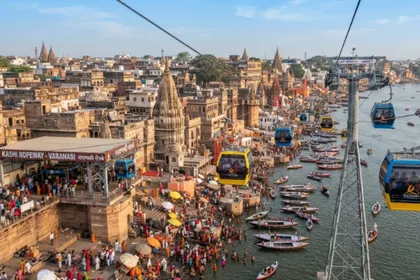
Ever since he adopted Varanasi as his political capital 12 years ago, Modi has imposed his vision upon the city. Under his authority, thousands of crores have been sanctioned to demolish, construct, or renovate: from a corridor around the Kashi Vishwanath temple (KVT) to a convention centre, sports stadia, expressways, ports, an urban ropeway, even a new ghat named Namo, so called after the giant namaste sculptures by the riverside or as an unsubtle ode to the shortened form of Modi’s name.
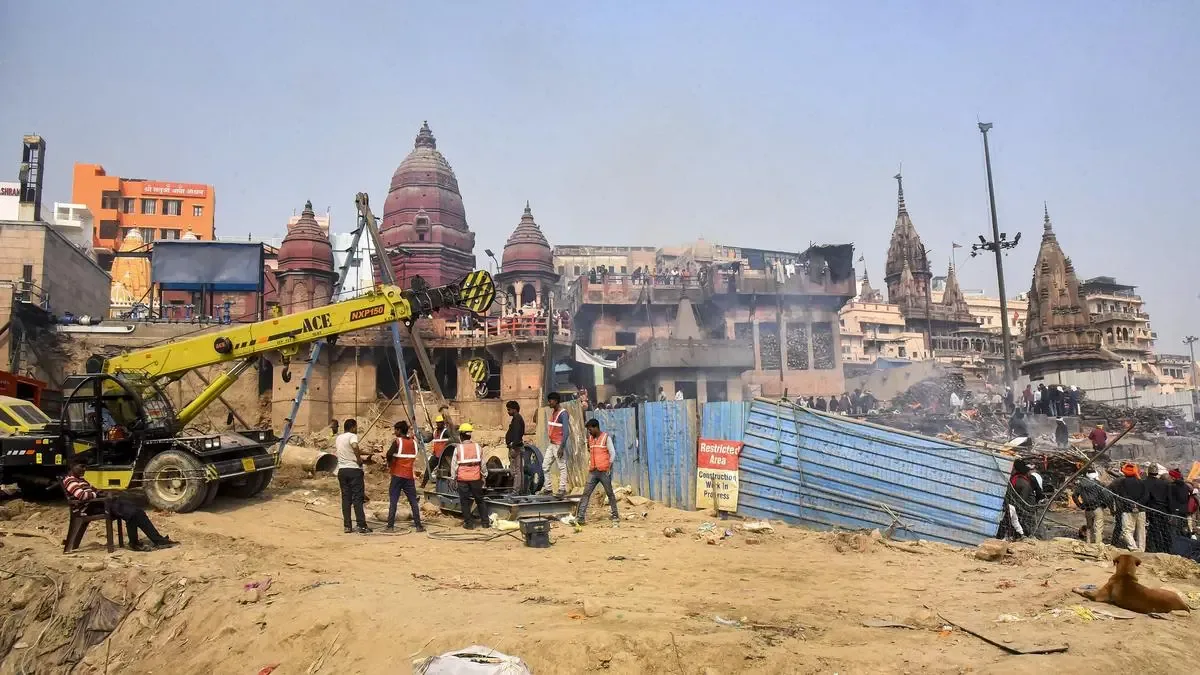
But the city authorities perhaps did not expect the furore that followed the latest “redevelopment” project at Manikarnika. In January 2026, viral videos showed bulldozers tearing through much of the lower structure of the ancient ghat, including madhis (raised platforms)and other structures. A protester said: “Under the guise of development, the original character of Manikarnika Ghat was being tampered with and the city’s heritage was being destroyed.” Soon, many opposition leaders, local and national, joined in the chorus of disapproval, blaming Modi for defacing the “centuries-old religious, cultural, and spiritual heritage” of this sacred space. Soon after, Modi’s party ally and Chief Minister of Uttar Pradesh, Adityanath, claimed that some of the viral clips of demolition were AI-generated. Eight FIRs were filed in January against those who shared the videos, and dozens were arrested for planning to protest against the project.
I visited the ghats in March, after the initial shock of the demolition, to see how the daily cremation traditions at Manikarnika have adjusted to the tense climate. Half of the ghat area had been cordoned off by blue metal roofing sheets as bulldozers dug deep into the earth. Meanwhile, cremations continued as usual on the kuchha (temporary)grounds on the other side and atop some nearby buildings and pavilions.
I climbed a staircase to the rooftop of a pavilion, where a small number of funeral workers—all men from the Dom caste, who are known as Doms in common parlance—had set up cremation pits. The duties to conduct Hindu cremation procedures are reserved here only for the Dom caste:in Varanasi, most Doms consider themselves to be part of the extended family of the Dom Raja—the “king” of the caste of cremators—who resides in a palatial kothi (house)overlooking the river a few ghats south of Manikarnika.
The soil up here was a little soft and muddy under my shoes. Leaning over the parapet of the pavilion, I gazed at the construction work going on below and saw bulldozers, men in safety helmets, a new scaffolding erected close to the river, and engineers intently studying their blueprints. Raju, a Dom in his 20s, walked around a cremation pit he had been working on to stand beside me. He wore a vest and a dhoti and was sweaty from a warm morning spent in close proximity to the flames of the many bonfires. We watched the proceedings from atop for a few minutes.
“He has broken every brick here,” Raju said. He wore a wry expression of defeat, an almost fatalistic acceptance that such decisions lie in the hands of bigger men, like him. Raju smiled, popped open a packet of gutka and rubbed the chewing tobacco between his gums. “And he will continue to break more.”
***
Tracing its civilisational roots to around the 9th–10th century BCE, Varanasi or Banaras or Kashi is one of the oldest continuously lived cities in the world, and ghats like Manikarnika and Harishchandra offer a small glimpse of its ancient past that still lingers at every turn of the city’s older mohallas (localities). The city is so old that it finds a mention in Hindu scriptures. According to “Kashi Khanda”—the fourth book of the Skanda Purana, a Hindu religious text dating back to the 8th century CE—the kund (water reservoir) at Manikarnika was the site of the original creation, made by the chakra (discus) of the god Vishnu. “In Varanasi that is the spot for the grant of salvation for me. In all the three worlds there is nothing similar to the dust particles of that spot” (“Kashi Khanda”, 79:91). Devotees still gather at Chakra Pushkarini Kundon occasions such as Akshaya Tritiya to bathe in the waters, hoping to earn spiritual merit.
A man tends to a burning funeral pyre at Harishchandra Ghat, on the banks of the Ganga, in Varanasi. | Photo Credit: NIHARIKA KULKARNI/AFP
Vishnu is said to have presented this ground as a wedding gift to Shiva and Parvati. Beside the ghat, there is a set of footprints, representing Vishnu’s, carved into a marble slab on a lotus pedestal.
The American religious studies scholar Diana L. Eck argues in Banaras: City of Light (1982) that, at the time of the writing of “Kashi Khanda”, Varanasi already had the reputation of having stood “at the beginning of time when no other ‘place’ existed, the place from which the whole creation came forth in the beginning and to which it will all return in the fire of time’s end”. She writes later of Manikarnika:
“It is said to be the place of the earth’s creation as well as its destruction, containing both the sacred well, dug out by Vishnu at the beginning of time, and the cremation ground, where the created order burns at the end of time. Both the waters of creation and the fires of destruction join in the aura of sanctity that pervades Manikarnika.”
Sometime around this mythological act of creation, however, there was a mishap. Parvati misplaced her valuable kundalas (earrings). In Chapter 26 (Skanda Purana translated by G.V. Tagare, 1950) of “Kashi Khanda”, Parvati addresses Vishnu, saying:
“On seeing the steady increase of this penance of yours, I shook my head having serpents. As a result of that movement, my gemset earring fell down. It was set with jewels and was beautiful in appearance. Let this (sacred expanse of water) be named Manikarnika.… Let it become famous by the name Manikarnika here in this world, ever since the time when the gemset earring fell into it from my ear.”
Where every space is hallowed
In another version of the story, the celestial couple were bathing together in Manikarnika Kund when Parvati (perhaps purposely) dropped her earrings into the water (and in some legends, asked the help of the goddess Ganga to hide them). Parvati told Shiva that they could not leave the city until he retrieved her lost possession. The earrings were never found, and thus Shiva never forsook the city.
Tales like these are part of the reason why Varanasi is sometimes known as Avimukta, that which is never forsaken by Shiva, or Rudravasa, the city of Shiva. Many residents of Varanasi—Banarasis—still believe that Shiva continues to be an active part of the local community, and his multifaceted personality is echoed in the sometimes carefree, sometimes frolicsome, sometimes intense, sometimes compassionate character of the city. There are thousands of Shiva temples here, including the most popular of them all, the KVT, a place that is loosely considered to be Shiva’s cosmic headquarters. A popular local axiom says: “Kashi ke har kankar mein Shiv Shankar” (Shiva resides in each little pebble of Kashi).
According to Hindu scripture, every living being—people, pigeons, oxen, rats—that dies in Varanasi is given a priceless final blessing: a conversation with Shiva in the form of a mantra whispered in the ears of the departing soul. Called the Taraka Mantra, the chant brings about liberation from the painful cycles of life and death. It is a spell that has been called “the very cure to the disease of samsara”. “Kashi Khanda” says: “Beginning with Brahma and ending with a blade of grass, there are numerous living creatures in the four species of living organisms. Let all those attain salvation in Kasi” (26:69).
Like other Indian cities, Varanasi has many historic mandis (marketplaces): a sabzi mandi for vegetables; the Kachauri gullyfamous for the deep-fried stuffed pastries and other roadside snacks; Thatheri Bazaar, known for brass, bronze, gold, and silver materials; and the Benia Bagh area renowned for its saris and dress material, and more. In a similar vein, the cremation ghats, Manikarnika and Harishchandra, have operated as the mandis of death, where for centuries commerce has been conducted over wood for the pyres, the muslin or silk cloth with which corpses are draped, prayer materials, and crucially, the handling of the cremation process itself, for which the Doms ask for unofficial “donations”, depending on the social status and wealth of the bereaved family.
In most Indian cities, shamshaans (cremation grounds) are outside the main town and often to the south, the direction sacred to the Hindu god of death, Yama. But such rules are discarded in Varanasi—a city denoted as a mahashamshaan (grand cremation ground), where every space is hallowed, fit for the sacred funerary rites.
According to inscribed evidence, Manikarnika was the first ghat to be constructed of stone in the city, in the year 1302. It defied traditional urban geography with its placement northwards, close to the city centre where people lived, worked, and prayed. Due to the sacredness conferred upon this area by the scriptures, Manikarnika may have already been an established cremation space where antyesti ceremonies were performed close to the “original” creation ground, by the waters where Shiva is believed to await each departing soul with a whisper of liberation. Perhaps this is why, anecdotally, many Banarasis claim that the fire used to alight every corpse here comes from a pit that has been burning for thousands of years.
The Maratha connection
Fast forward some four and a half centuries, and Varanasi had begun to enjoy the patronage of the royals from Maharashtra. The academic Rana P.B. Singh writes that the 18th century brought “a fresh wave of cultural renaissance” which “substantially rebuilt the city” after the demolition and rebuilding efforts of the Mughal emperor Aurangzeb in the century prior (Banaras, The Heritage City of India: Geography, History, and Bibliography, 2009). In History of Benares: From the Earliest Times Down to 1937 (1937), the historian Anant Sadashiv Altekar writes: “Modern Banaras is largely a creation of the Marathas.” The Marathas are credited with rebuilding the Manikarnika complex over its original structure in the 1730s, under the patronage of Peshwa Bajirao I.
Workers of Samajwadi Party workers protest against the demolition at Manikarnika Ghat, alleging insult to Ahilyabai Holkar’s legacy. Lucknow, January 22. | Photo Credit: SANDEEP SAXENA
Among these Marathas was Rani Ahilyabai Holkar, the queen of the erstwhile Indore state. It was under her that restoration work was conducted at Manikarnika Ghat in the 1770s. The ghat was fully constructed, with its stone-paved steps, platforms, cremation spaces, and surrounding temples, by 1791. Holkar also rebuilt the KVT—called the “beating heart” of the city—in 1780, over a century after it was demolished by Aurangzeb.
Over time, Manikarnika and Harishchandra Ghat, further south, became the punya bhumi (sacred ground) for cremation. Dhrub Singh, a faculty member at the Department of History in Banaras Hindu University, told me that over the past millennia, Varanasi was construed as an important teertha (pilgrimage) site for Hindus by priests who served as the guardians of its spiritual reputation. “There is a sense of achievement if you manage to pass your last days here. And this has been reinforced continuously,” Singh said. Singh spoke of the great line of prominent individuals—philosophers, kings, prophets, poets, politicians—who chose to reside in Varanasi and die there. This, he said, “created an enduring imagination [about the city]. And that enduring imagination is fed partially by reality. I think this had a synergic effect, and it endures in the mind of people.”
Harishchandra Ghat is no less revered. Archaeological evidence suggests that this ghat has been used for cremation since the 15th and 16th centuries CE and was known as Adi Manikarnika, or the original Manikarnika. Mythology speaks of the connection between Raja Harishchandra—a king of Ayodhya’s Ikshvaku dynasty and an ancestor of Ramfrom the Ramayana—and Varanasi.
When the venerated sage Vishwamitra wanted to test the king’s legendary generosity, he asked Harishchandra for a number of dakshinas (offerings). The king gave away his kingdom and riches, even sold his wife and son to a life of servitude, to fulfil the sage’s demands. Eventually, Harishchandra himself was sold as a slave to a man of the Chandala community (a caste group entrusted with the “polluting” job of handling corpses) in Varanasi. Tasked with overseeing cremations by the ghat side, Harishchandra was tested to the extreme when the corpse of his own son was brought for cremation. When his queen could not afford to pay for the last rites, Harishchandra asked her to sell her mangalsutra, the sacred necklace that was the symbol of their marriage. The tragic scenes stirred Vishwamitra’s conscience, and the sage, now convinced of the king’s righteousness, restored to Harishchandra his freedom, his kingdom, his riches, and his son’s life.
If Manikarnika offers posthumous salvation, the story of Raja Harishchandra and his namesake ghat is a morality tale suggesting that there is the possibility of salvation in life itself if one dutifully follows the path of dharma.
In the 1980s, the city administration took a bold step towards modernity, installing an electric furnace for cremation in addition to the traditional wood-fired pyres. This is where my grandfather was cremated in the late 1980s.
The blueprints and plans for the proposed reconstruction at Manikarnika had been publicised long before the demolition began. When completed, the new Manikarnika Ghat will include dozens of open and covered cremation platforms, VIP seating on the roofs, ramps, viewing areas, wood plazas, CCTV presence, and other special arrangements. There are plans for a wider entrance plaza and the broadening of the narrow lanes around the ghat to ease the movement of funerary processions. The new design will also ensure that cremations are not disrupted by the occasional heavy flooding of the Ganga: when the river is in spate during the monsoon, submerging the ghats, pyres have to be lit on nearby rooftops. In addition, the redesign promises to “restore” adjacent heritage sites, including Chakra Pushkarini Kund, the Ratneshwar Mahadev temple (the famous “leaning temple”), and more. Edifice Consultants has partnered with a Gorakhpur-based startup, Urja, that is offering a patented technology for a wood-based cremation process that will be pollution free.
The Gyanvapi Mosque stands beside the Kashi Vishwanath Temple. For years it has been mired in litigation and controversy. | Photo Credit: SANDEEP SAXENA
Edifice has claimed that, under the proposed system, cremation time will be greatly reduced (to 90 minutes from the current 4 hours). The consultancy’s founding director, Ravi Sarangan, was quoted as saying: “The design [of the crematoriums] includes a workflow to streamline the cremation process and covers development and beautification of the courtyards through ambient landscaping and play of lights” (“The makeover of Varanasi’s historic burning ghats: Manikarnika, Harishchandra to undergo eco-friendly revamp by 2026; balancing faith and future”, The Times of India, September 2, 2025).
From the time the digging began in 2023, the riverside walk across the ghats was interrupted: pedestrians had to walk on makeshift muddy paths and through gulliesto make it past the early construction work. It was inconvenient, but Banarasis had faced inconvenience before too in the Modi era. Despite its religious significance, the city has long been characterised by a dismal state of infrastructure, public services, sanitation, law and order, public education, healthcare, transport, and so on. In April 2014, before the Lok Sabha election, Lakshman Prasad Acharya, the senior BJP leader from Varanasi, told the BBC: “This ancient city has been neglected because of a lack of leadership. So now the voters are very happy that Mr Modi is contesting from here, and they believe that this backward area will see some development.” Modi, of course, went on to win Varanasi, which gave him direct access to one of the spiritual cores of Hinduism.
‘City of Light’
Since the 2014 victory, Modi has comfortably played a double role as a political leader who operates out of the PMO at the Central Secretariat in New Delhi and a Hindu saint who commands centre stage in the religious ceremonies in the temples of Varanasi. A release by the Press Information Bureau in April 2025 noted: “From 2014 to March 2025, 580 projects were taken up under Kashi Development with a total investment of ₹48,459 crore.”
A few weeks before the start of the 2019 Lok Sabha election, Modi laid the foundation stone of the Kashi Vishwanath Mandir Vistarikaran-Saundaryakaran Yojana (Kashi Vishwanath temple extension and beautification plan), to build what is now known as the Shri Kashi Vishwanath Dham Corridor, consisting of the larger space around the KVT. Estimated to have cost around Rs.800 crore, the project is one of the most expensive facelifts the city has ever received.
Kashi means City of Light, and for centuries, the KVT has served as the solar centre giving the city its radiance. Varanasi grew in orbits around this golden centrepiece, in narrow corridors where people lived, prayed, studied, worked, sang, danced, ate, drank, lazed, wed, procreated, and died, all within an easy walk down the cobble-stoned paths to the riverbanks. For many Banarasis who lived in the old Pucca Mahal area, a visit to the temple was part of daily routine, sandwiched somewhere between a dip in the Ganga and opening the shutters of their workspaces. The mixed community here, made up of scholars and boatwallahs, jewellers and weavers, exuded the signature Banarasipan (essence of Varanasi), marked by tolerance and cosmopolitanism.
Then, in 2019, construction began for the Kashi Vishwanath Corridor Project. Some 300 homes and shops occupied by long-term residents or their tenants were vacated and destroyed in the first phase of the project. Landowners and shopkeepers were given some token compensation for their loss and told to find another place to restart their lives. Suddenly, the lively community life around the temple fizzled out, the raag of the Pucca Mahal area replaced by the drone of bulldozers. Centuries-old peepal trees were felled and hundreds of smaller temples were razed. The sacred Akshayvat (banyan) tree within the temple’s complex was brought down. In the debris of demolition, over a hundred ancient Shivlings were discovered as smaller temples and cocoons of worship were wrecked to facilitate the construction of a single monolith in the middle.
The corridor was officially inaugurated by Modi with much bombast in December 2021. Since then, the city has received a flurry of attention and has been transforming fast. Varanasi’s tourism industry has been boosted with a jolt of lightning. The State government revealed that Varanasi was visited by 7.6 crore tourists in 2025. This included an exponential increase in foreign tourists, helping Varanasi overtake traditional hot spots like Goa and Shimla to become the top tourist destination in India. Between 2014 and 2025, the State Tourism Department estimated that some 45 crore tourists had visited Varanasi.
Having left an indelible imprint on Varanasi, Modi won again from there for the third consecutive time in the 2024 Lok Sabha election. But the elections results revealed the hollow core beneath the shiny veneer of “development” in the holy city. His victory margin of 1.5 lakh votes over Ajay Rai of the Congress was his lowest ever in the city, less than his victory margins in 2019 and 2014. There were several factors behind this, but one of the most apparent were the rumblings of discontent over the very corridor that was Modi’s flagship project in Varanasi.
The temple’s central location in the old city had ensured that residents had multiple pathways and gates to perform a darshan—even if it was a quick, hand-folded greeting—of the jyotirlinga that sits under the temple’s golden dome. This jyotirlinga is considered to be the most auspicious among the dozen such representations of Shiva in India. As soon as construction for the corridor began, many gulliesand gates leading to the temple were closed off to the public. Registration requirements and the paid sugam (VIP) darshan have curtailed temple access for local people. Even as many Banarasis have benefited financially from the tourist bonanza, their spiritual connection to the temple has diminished.
Despite these and other misgivings, Modi remains popular in Varanasi, building on the successful grassroots network of the RSS and other BJP-affiliated right-wing organisations and the sense of prestige felt by many local people at being directly represented by the most powerful man in the country. Many have been swayed by the government’s social development schemes and expensive infrastructure facelifts around the city. Future projects include a Rs.450 crore international cricket stadium in Ganjari village in the city’s outskirts. It is to have floodlights resembling Shiva’s tridents. The Ganga Elevated Corridor project connecting National Highway 19 with the Varanasi Ring Road, estimated at Rs.14,447.64 crore, is on the anvil. The world’s tallest Shivling has been planned in the Bhelupur area. Most audaciously, Varanasi will soon feature India’s first urban ropeway, a 4-kilometre-long overhanging path with nearly 150 cable cars, built at a cost of over Rs.800 crore.
Meanwhile, bulldozers have made their way into the heart of the city. Not far from the KVT is Dal Mandi, a bustling bazaar populated mostly by Muslim families that has attracted both local people and visitors for centuries. In July 2025, the State Cabinet officially approved a road-widening project to create a new accessway to the temple. A tense demolition drive was initiated in which centuries-old structures, including shops, schools, hospitals, homes, and old kothas, were flattened. Some residents have protested against the unfair compensation, and some the loss of property and neighbourhood.
Narendra Modi speaks during the inauguration of the Shri Kashi Vishwanath Dham Corridor, a promenade connecting the Ganga riverbank with the Kashi Vishwanath Temple. December 13, 2021. | Photo Credit: Rajesh Kumar Singh/AP
In February 2026, a man allegedly set his own shop on fire to protest against the demolition, leading to chaos and detainments. In June 2026, the Northern Railways controversially issued a notice for the removal of the Ganj Shaheeda mosque located near the first gate of the Kashi railway station. The Anjuman Intezamia Masajid Committee rejected the notice, challenging the allegation of encroachment. And beside the KVT stands the Gyanvapi mosque, which has for years been mired in litigation and controversy, fighting claims that a Hindu temple once existed on the site. There is an uneasy peace between the temple and the mosque for now, shielded by constant, heavy security.
In January, shocked onlookers around Manikarnika filmed bulldozers demolishing platforms and madhis on the northern side of the ghat, including centuries-old statues of Ahilyabai Holkar that were sculpted into the platforms. In a city that has felt permanent, the swift demolition drive struck a nerve, and even the government seemed to be unprepared for the public rage that followed. Citizens protested offline and online to visuals of the destruction. Members of the Maratha community, in particular, were enraged at the disrespect to Holkar’s legacy. Opposition leaders pounced on the opportunity to lay blame on the Prime Minister. On January 15, in an X post addressed to Modi, Congress president Mallikarjun Kharge wrote (translated from Hindi):
In the name of tasteless beautification and commercialisation, you (PM) have run bulldozers at Manikarnika Ghat in Banaras, destroying centuries-old religious, cultural and spiritual heritage. You want every piece of historical heritage to be erased and just your nameplate stuck on it.
Meanwhile, Modi’s principal detractor in Varanasi, Ajay Rai, called the renovation project an attack on the city’s soul. City and state administrators attempted to quell the anger through many stages of denial, deterrence, and defiance. The District Magistrate claimed that the artefacts had been “secured” by the culture department and would be restored in their original form after the renovation work was completed. A member of the Dom Raja’s family rejected the allegations of idol destruction.
Police forces were dispatched to Manikarnika to guard the construction efforts from protesters. Dozens were detained for attempting to protest at the ghat, and many were booked under various sections of the Bharatiya Nyaya Sanhita relating to destruction of places of worship and outraging religious sentiments, strangely, not for the actual demolitions, but for sharing their visuals. Within days, many mainstream media houses published the party line that the demolitions are part of the modernisation project. There was almost no reference to the heritage of the ghats being modernised.
The absurdity reached its zenith when Adityanath claimed that the visuals of destruction were generated by the opposition party using AI. In blankly Orwellian terms, he asked citizens to reject the evidence of their eyes and ears and warned of strict action against those sharing the videos.
‘They’ve broken so many temples’
The construction hit a snafu when I was in Manikarnika in March. Local people told me that the demolition team had dug a little too deep, and further up the land than they had initially planned. So, structures around the ghat—some of the temples, storehouses, shops, and other buildings—now faced the threat of land subsidence.
This is not a new phenomenon: geologists reported two years ago that the ghats around Manikarnika were sinking due to over-exploitation of water in the rapidly urbanising city. A wood-seller seated to the south of Manikarnika told me it was being called a danger zone. Tourists and other pedestrians were being asked to walk further up the ghat steps and around before descending to the next ghat north.
Bhrigu (name changed) works at a small chai stall by the ghat. His pedestal used to oversee the ghat and cremations, and it had stood there for some 35 years, passed down the family for generations. Now Bhrigu’s view of the ghat is blocked by the roofing sheets, but through the tiny slits between each sheet, he can look at the implausible scene of bulldozers turning a familiar landmark—which once felt eternal—into dust.
Cremations continue at Manikarnika since death does not wait for the completion of any yojana. | Photo Credit: V.V. KRISHNAN
Stalls like this—a place for some chai and some charcha (discussion)—have long served as the social orbital centre for Banarasi men. A small group of men sat around the stall when I asked Bhrigu about the construction and how long it would continue. In a defeated voice, he said: “For as long as Modi wishes.”
I pointed at the Mahashamshaan Baba Mandir, a temple to the south of the ghat, and asked if this would be demolished, too. There was an awkward silence. Bhrigu looked at the faces of friends and regulars around him and finally said: “They’ve broken so many temples.”
A little ahead of the chai shop, there was another path on a ghat terrace from where the construction could again be seen. Here, I met Ashok (name changed), a part-time tourist guide, who shared the sudden shock of seeing a familiar landscape from his childhood get quickly defaced. “This place is hundreds of years old,” said Ashok, “With one jhatka [a sudden blow], they have destroyed it.”
“No matter what they build here, it will never be an improvement to the raunak (radiance) this place had,” Ashok said and added: “Every place has a symbolic pehchan [identity], and they have destroyed the pehchan of this place.”
Ahead of us, there was a jarring absence of the city’s pehchan, an emptiness where there was once history. The demolition of a site like Manikarnika is akin to demolishing any of the ancient wonders and heritage zones of the world merely because they do not fit into ideas of modern architectural aesthetics and convenience. But even that comparison pales because many of the world’s ancient sites now stand only as tourist places, offering a glimpse of the past; in this, they are unlike Manikarnika, where there was never a pause in history, where the past has continued in the present.
A group of priests sat on the madhis at Scindia Ghat, next to the northern construction site of Manikarnika. The priests have called these places their home for centuries. Often seated on chaukis (wooden stool) under bamboo chhatris (umbrella), they help pilgrims perform pind daan, a ritual in which an individual offers small morsels of food and water as libation to the spirit of their departed ancestors.
I spoke to one such priest, Vinod, who claimed to be a seventh-generation Banarasi, with ancestors who migrated here from Gujarat over a century ago. For months, the demolition at Manikarnika had been taking place just a stone’s throw away from his usual spot. After the initial dismay, Vinod, like many others, was now worried about the consequences of complaining too much. “If you make too much noise, they’ll throw you in jail,” said Vinod. “If anyone makes a video here, they will put handcuffs on them and take them away.”
Not too far from the ghat was the KVT, which Vinod and many of his fellow priests once frequented almost on a daily basis before the corridor came up. “It’s been years since I’ve been to the temple,” he said. “How will I go? There is so much crowd. I would have to spend 2-3 hours lining up. And after that, no sooner have you bowed your head before Baba [the jyotirlinga] than someone pushes you ahead. What does darshan mean? If I’m looking at you, let me look at you properly. That is darshan. This isn’t darshan.”
“Tell me, now,” he asked, “who is to be blamed for all this?”
I walked down from Manikarnika Ghat, towards the dozen or so active pyres on flat pockets of land on the decline towards the Ganga. Wisely, the ghat renovation was being done in stages, allowing for cremations to continue on one half of the ghat while the other half was partitioned with giant metal sheets. The sound of bulldozers came from the other side of the partition, but death does not wait for the completion of any yojana.
It was a warm March day, and the bonfire of human bodies turned the riverside even hotter. There were small crowds around each pyre, some men handling the wooden lattice of the pyres, some chatting, some smoking, some looking into their mobile phones, some sitting beside fresh, wrapped corpses, awaiting their turn. In the past, the shamshaan ghats of Varanasi had a strict policy preventing photography or videography of the pyres. There were even rules against women descending the steps, whether they were grieving family members or curious tourists enthralled by the exoticism of the open cremations.
No such prohibitions seemed to exist now: men and women milled around the bodies, some photographing the fires, some photographing themselves with strangers burning in the background. Boats filled with logs waited at the riverside. Piles of trash, including the discarded clothes of the dead, flowers, plastic food plates, and disposable chai cups, were piled up around the ghat.
One man beside a pyre made a video call to show someone on the other end a corpse, mid-cremation. The Dom who was assisting the process told the man that the burning process would take about half an hour more to be completed. Temple bells began to toll from above. A small pack of dogs found a quiet corner to doze in the afternoon.
One of the cremations was nearly over, and a Dom performed the final act of mukti, cracking open the skull, known as kapalakriya, which is believed to officially release the soul from the body.
I walked back up from the ghat, keeping a safe distance from the pyres. Suddenly, a strong gust of wind aggressively pushed the flames of a pyre in my direction. I ducked the lashing fury of the flames and soon was safely back to the stone-cobbled path above. But I was left shaken by the heat; it continued to vibrate against the skin, like a forewarning of things to come.
Karan Madhok is the author, most recently, of the novel Monkey! He also wrote Ananda: An Exploration of Cannabis in India, and A Beautiful Decay.
Original link: https://frontline.thehindu.com/arts-and-culture/heritage/manikarnika-ghat-demolition-varan
If you are the publisher of this material and would rather it were not here, write to info@banaraslive.com.